[ybsrl] Download European Soft Pro fonts from Bülent Yüksel

European Soft Pro
European Soft Pro European Soft ProEuropean Soft Pro


EUROPEAN SOFT PRO


ABOUT FAMILY:

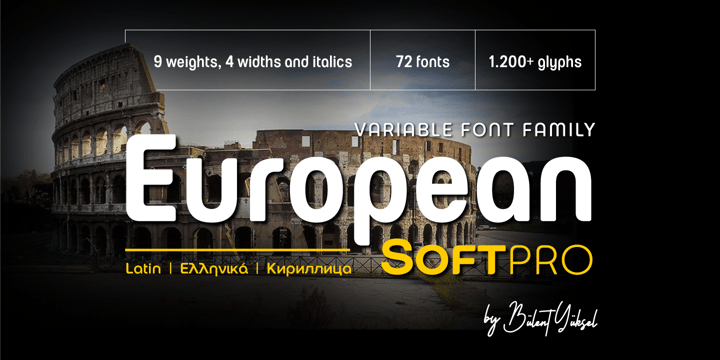
What makes "European Soft Pro" elegant, friendly and contemporary is its very rounded curves with very open terminals.


"European Soft Pro" has been designed with a higher "x-height" than other fonts in its class to make tiny readability more obvious in any use situation. It will be ideal for use in small sizes such as business cards or mobile applications.


This typeface is also equipped with powerful OpenType features to satisfy the most demanding professionals. It has solid features like case sensitivity, small, true capitals, full ligatures, tabular figures for tables, old style figures to elegantly insert numbers into your sentences and more alternative characters to give personality to your projects.


The extended, "European Soft Pro" supports around 85 languages in the Latin, Cyrillic and Greek scripts, and its non-Latin components were developed with native consultants. With over 1200+ glyphs per style, "European Soft Pro" cares about localised letterforms and has the OpenType features to match.


FEATURE SUMMARY*:

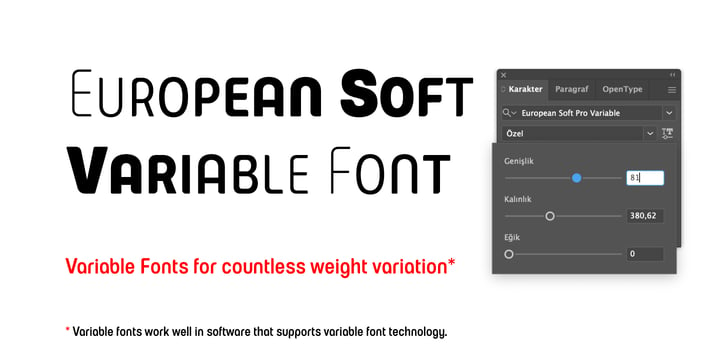
- Variable Fonts*** for countless weight variation**.

- 9 weights: Thin, ExtraLight, Light, Book, Regular, Medium, Bold, ExtraBold, and Black.

- 4 widths: Normal, Narrow, Condensed, and Extra Condensed.

- Matching italics (12º) for all weights and widths .

- Matching small caps for all weights and widths.

- Lining and old style figures (proportional and tabular).

- Alternate characters (A, G, M, N, R, U, a, g, l, m, n, u, y).

- Unlimited fractions.

- Automatic ordinals (1st, 2nd, 3rd, etc.).

- 24 Dingbats + 19 Social Media and Block Chain icons.

- Extended language support: Most Latin-based scripts (including Vietnamese), Cyrillic, and Greek.

- Extended currency support.


NOTES:

* Some features require OpenType and/or Unicode support.

** Variable fonts work well in software that supports variable font technology.

*** Using "Type > Convert Outlines" when creating PDFs in older versions of "Adobe InDesign" eliminates letter corruption. The definitive solution is the latest "Adobe Version 15.0.2".


You can contact me at buyuksel@hotmail.com, pre-purchase and post-purchase with questions and for technical support.


You can enjoy using it.


European Soft ProDownload NowView Gallery


Popular posts from this blog

[exjrh] Download Koch Schrift fonts from Ingo

Koch Schrift A heavy blackletter; Rudolf Koch’s first type from 1909. On an old page full of type specimen from the 1930s, the type is described as ”Schwabacher (used by the Deutsche Reichsbahn [German Imperial Railway]).“ As a matter of fact, it is the first print of the Offenbach script master Rudolf Koch, who came out with this typeface in 1909. At that time, it was given the name ”Neudeutsch“ (New German). Later, it became very popular under the name Koch-Schrift, and was at times the official typeface of the Deutsche Reichsbahn (German Imperial Railway). Koch Schrift Download Now View Gallery

[gdueh] Download Pontina fonts from KaiserType

Pontina Pontina is the name of a multilingual didone font family. It consists of three different weights: regular, bold and extra-bold. It’s character is built up of playful and lively strokes, that gives the classical forms a modern individual touch. All font styles were drawn by hand while there was no interpolation used. Pontina can be used for headlines as well as short textpassages. It comes along with a set of different ligatures as well as swash letters for initials. Pontina Download Now View Gallery

[naihh] Download Bakemono fonts from Zetafonts

Bakemono Francesco Canovaro created Bakemono as a way to explore the design space around the duality of fixed/proportional width. He was also interested in the concept of monowidth design , inherent in monospaced typefaces, that can bring flexibility and ease of use also to proportional type - allowing you to change the weight of a word without losing the text alignment. In his research on fixed width type design he mixed the lessons of mechanical typewriter technology with the intuitions of eastern brush calligraphy , which has been dealing with for centuries with fixed space grids. The name of the typeface comes from the Japanese shape-shifter yokais that could change their form freely between human and animal, and aptly describes the metamorphic nature of this wide superfamily coming in proportional, monospace and intermediate subfamilies. With a design mixing the expansion principles of the brush with the sharp technicality of typewriter and system fonts, Bakemono can bo...