[glxbh] Download Duplet Open fonts from Indian Type Foundry

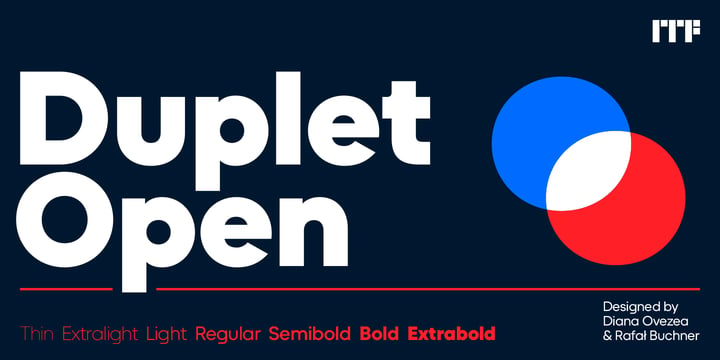
Duplet Open
Duplet Open Duplet OpenDuplet Open


When you are looking for a typeface that can carry a tech message to readers, helps make communication easier and looks good, too – chances are high that you’ll select a geometric sans serif. These are the typefaces of today and tomorrow. From the headlines on news websites to the texts in apps and even company logos rendered large or small, geometric sans serifs are everywhere.


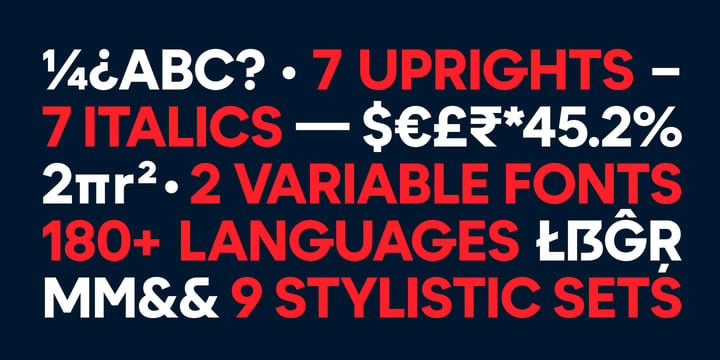
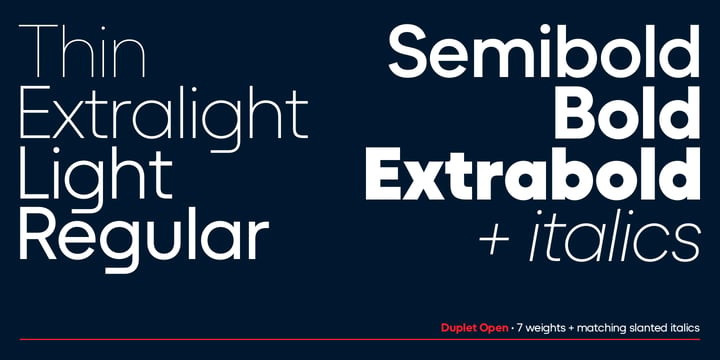
Since it is part of the Duplet superfamily, you can combine Duplet Open with its relatives: Duplet and Duplet Rounded. Each contains seven weights ranging from Thin through ExtraBold, all with companion italics. The fonts include more than 450 glyphs, covering all the European languages written with the Latin script.


Since the Duplet Open fonts are geometric, the round characters and round-parts of letters appear either as circles or slanted circular forms (like you see in the italics). Duplet Open’s letterforms are very low-contrast with strokes that seem even in thickness. On letters like ‘e’ and ‘s’, the strokes also end in diagonal shears rather than horizontals. That makes the letters’ counters more open. They render a little less dark and may even be slightly more legible at small sizes or on screen than ITF’s Duplet family.


The default form of the ‘a’ in each font is single-storey. The large round bowl drives Duplet Open’s inherent geometry home! But there is a double-storey ‘a’ as an OpenType alternate ‘a’. The default ‘g’ is also single-story, and its bottom stroke is flattened, giving it a streamlined, less-complicated look. Duplet Open’s fonts feature three more ‘g’ versions as alternate characters.


There are alternates for ‘k’, ‘u’, ‘G’, ‘K’, and ‘M’, as well as the ampersand (&). The character sets include case-sensitive forms, too — punctuation marks that are vertically repositioned and look better in all-caps texts. When it comes to numerals, both proportional and tabular lining figures are there, as well as fractions, superior numerals, and inferiors. Diana Ovezea and Rafał Buchner designed this typeface with great attention to detail.


Popular posts from this blog

[exjrh] Download Koch Schrift fonts from Ingo

Koch Schrift A heavy blackletter; Rudolf Koch’s first type from 1909. On an old page full of type specimen from the 1930s, the type is described as ”Schwabacher (used by the Deutsche Reichsbahn [German Imperial Railway]).“ As a matter of fact, it is the first print of the Offenbach script master Rudolf Koch, who came out with this typeface in 1909. At that time, it was given the name ”Neudeutsch“ (New German). Later, it became very popular under the name Koch-Schrift, and was at times the official typeface of the Deutsche Reichsbahn (German Imperial Railway). Koch Schrift Download Now View Gallery

[gdueh] Download Pontina fonts from KaiserType

Pontina Pontina is the name of a multilingual didone font family. It consists of three different weights: regular, bold and extra-bold. It’s character is built up of playful and lively strokes, that gives the classical forms a modern individual touch. All font styles were drawn by hand while there was no interpolation used. Pontina can be used for headlines as well as short textpassages. It comes along with a set of different ligatures as well as swash letters for initials. Pontina Download Now View Gallery

[naihh] Download Bakemono fonts from Zetafonts

Bakemono Francesco Canovaro created Bakemono as a way to explore the design space around the duality of fixed/proportional width. He was also interested in the concept of monowidth design , inherent in monospaced typefaces, that can bring flexibility and ease of use also to proportional type - allowing you to change the weight of a word without losing the text alignment. In his research on fixed width type design he mixed the lessons of mechanical typewriter technology with the intuitions of eastern brush calligraphy , which has been dealing with for centuries with fixed space grids. The name of the typeface comes from the Japanese shape-shifter yokais that could change their form freely between human and animal, and aptly describes the metamorphic nature of this wide superfamily coming in proportional, monospace and intermediate subfamilies. With a design mixing the expansion principles of the brush with the sharp technicality of typewriter and system fonts, Bakemono can bo...